 Mancala Ukoo
The curious
You know mancala as Kalah – or not at all. The introduction starts from scratch, and Kalah and Oware put the familiar and the best-known traditional game side by side, for free.
Mancala is not one game but a family. Eleven of its games under their real names – with rules that are documented, not smoothed over.

For Android phones and tablets running Android 8 or later.
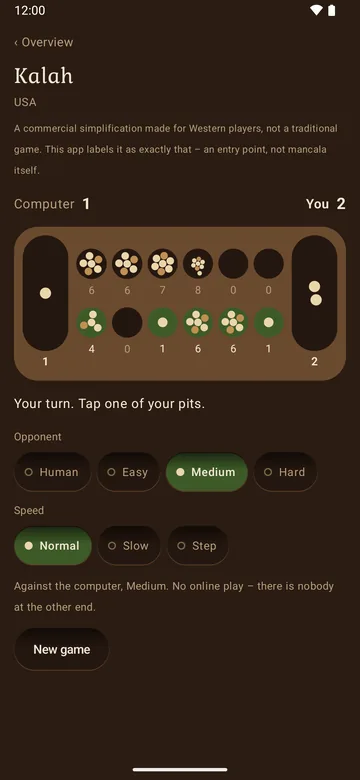
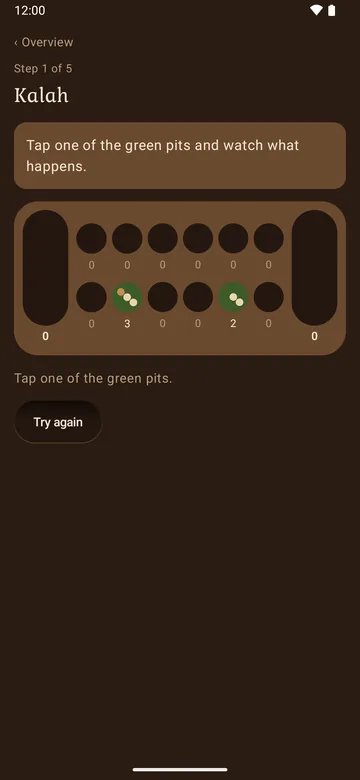
Kalah to try out, in your browser, for two players. In the app you can also play against the computer.
Sow, count, capture: seeds travel pit by pit around the board. Each game decides the winner in its own way – usually it’s whoever has gathered more seeds; in Bao, Omweso and Igisoro, the last player still able to move wins.
A five-step introduction on the Kalah board takes you through your first game – watch first, then make your own moves. The practice board is a shortened Kalah for a game that takes just a few minutes.
Three difficulty levels, or two players on one device. No online play: there is nobody at the other end, and the app does not pretend otherwise.
For every other game, the app shows how it differs from Kalah – with hands-on tasks to try before your first game.
For every game, the app states where it comes from, which tradition it follows and which source the rules are based on. Where traditions disagree, it tells you which one you are playing.
Kalah was patented in the USA in 1955 and is a simplification made for Western players. The app labels it as exactly that: an entry point, not mancala itself. Oware follows the Abapa tournament rules – including the duty to feed: if your opponent can no longer move, you must give them seeds. You win by gathering, never by starving them out.
Seeds never overlap: how many lie in a pit is the most important information in the game – which is why the number is also shown under every pit.
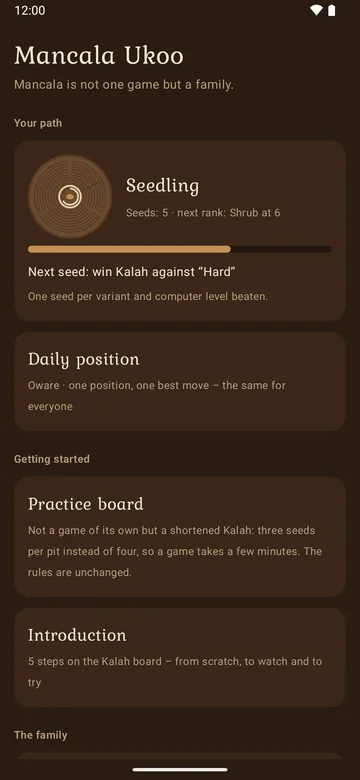
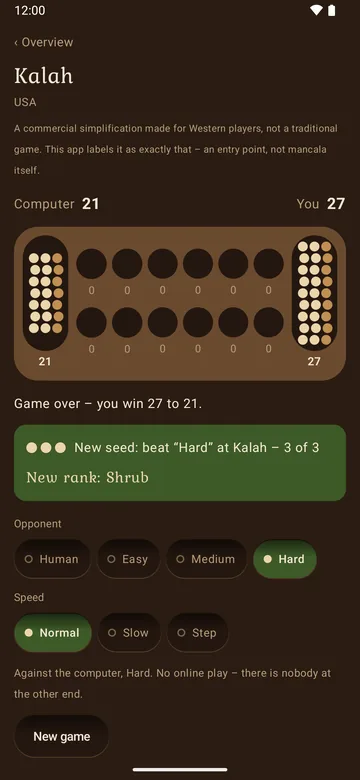
Every win against a new computer level earns a seed – one per game and level. Your tree rings grow with them:
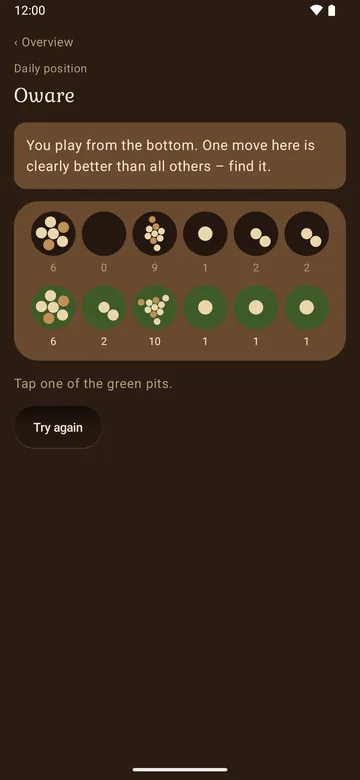
Daily position: every day, one position in Kalah or Oware, one best move, the same for everyone. No streaks, no reminders – play whenever you like. A rank, once reached, stays.
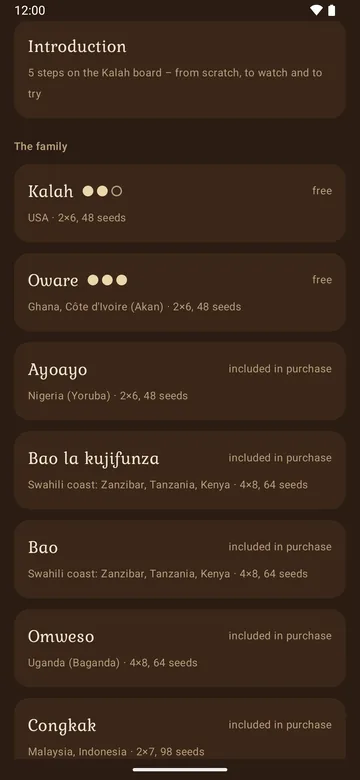
You know mancala as Kalah – or not at all. The introduction starts from scratch, and Kalah and Oware put the familiar and the best-known traditional game side by side, for free.
You want to play Bao with its two phases, Omweso on four rows or Igisoro from Rwanda – following a named source instead of invented rules.
One device, two players: the phone or tablet as the board between you, with no stones to hunt for and no miscounting.
No banners, no videos, no energy, no chests. No subscription. The only cost is a single one-time purchase.
$3.49
One-time. Opens the nine other games: Ayoayo, Bao la kujifunza, Bao, Omweso, Congkak, Sungka, Dakon, Endodoi and Igisoro.
Price in the USA as of October 2026 (Germany: €2.99). The price shown by Google Play at checkout is binding.
No. You play entirely offline. The app uses internet access only for purchases through Google Play – outside of a purchase, it transmits nothing.
No, and that is deliberate. You play against the computer or with two players on one device. We never pass off a computer opponent as a person.
Not yet. The app is available for Android phones and tablets.
No. No user account, no ads, no trackers. What you play stays on your device. The details are in the privacy policy (German).
No. The purchase is tied to your Google account. If the same account is signed in on the new device, the app picks it up automatically when it starts.
German, English, Spanish, French, Portuguese, Arabic, Hindi, Indonesian, Polish and Russian. The translations are machine-made and not checked by native speakers – the app says so itself.
That happens: regional traditions sometimes contradict each other. The app names its source for every game. If you know a different one, write to us at kontakt@wunderkammer-apps.de.
Kalah and Oware free, no ads, no account.